Mold is a silent intruder, often unseen but always unwelcome, spreading its microscopic spores throughout our living spaces. These airborne particles can trigger allergies, exacerbate asthma, and lead to various respiratory issues, leaving many searching for effective solutions. While air purifiers are a popular tool for improving indoor air quality, a crucial question arises: can they truly help with mold spores? The answer is a nuanced “yes,” but with important caveats. Air purifiers are highly effective in reducing airborne mold spores, particularly those disturbed during cleaning or movement, providing significant relief for individuals with respiratory sensitivities. However, they are not a standalone solution; they target the symptom rather than the root cause. This article will explore how air purifiers work against mold, the best technologies to look for, and how to integrate them into a comprehensive mold management strategy for a healthier home.
Understanding Mold and Its Impact on Indoor Air Quality
Mold is a type of fungus that thrives in damp, humid environments, reproducing by releasing tiny spores into the air. These spores are pervasive, existing both indoors and outdoors, and become problematic when they find a suitable environment with moisture and a food source to grow. Once established, mold colonies release more spores, volatile organic compounds (VOCs), and sometimes mycotoxins, all of which contribute to poor indoor air quality.
Exposure to mold spores can have various health impacts. For many, it triggers allergic reactions, leading to symptoms like sneezing, coughing, watery eyes, skin rashes, and a runny nose. Individuals with asthma may experience worsened symptoms, including wheezing and shortness of breath. Prolonged exposure can also lead to more serious respiratory problems, particularly in sensitive individuals or those with compromised immune systems. These microscopic spores easily become airborne through everyday activities suchates as walking across a carpet, opening a door, or simply moving air, making them a constant presence in affected environments.
How Air Purifiers Work Against Mold Spores
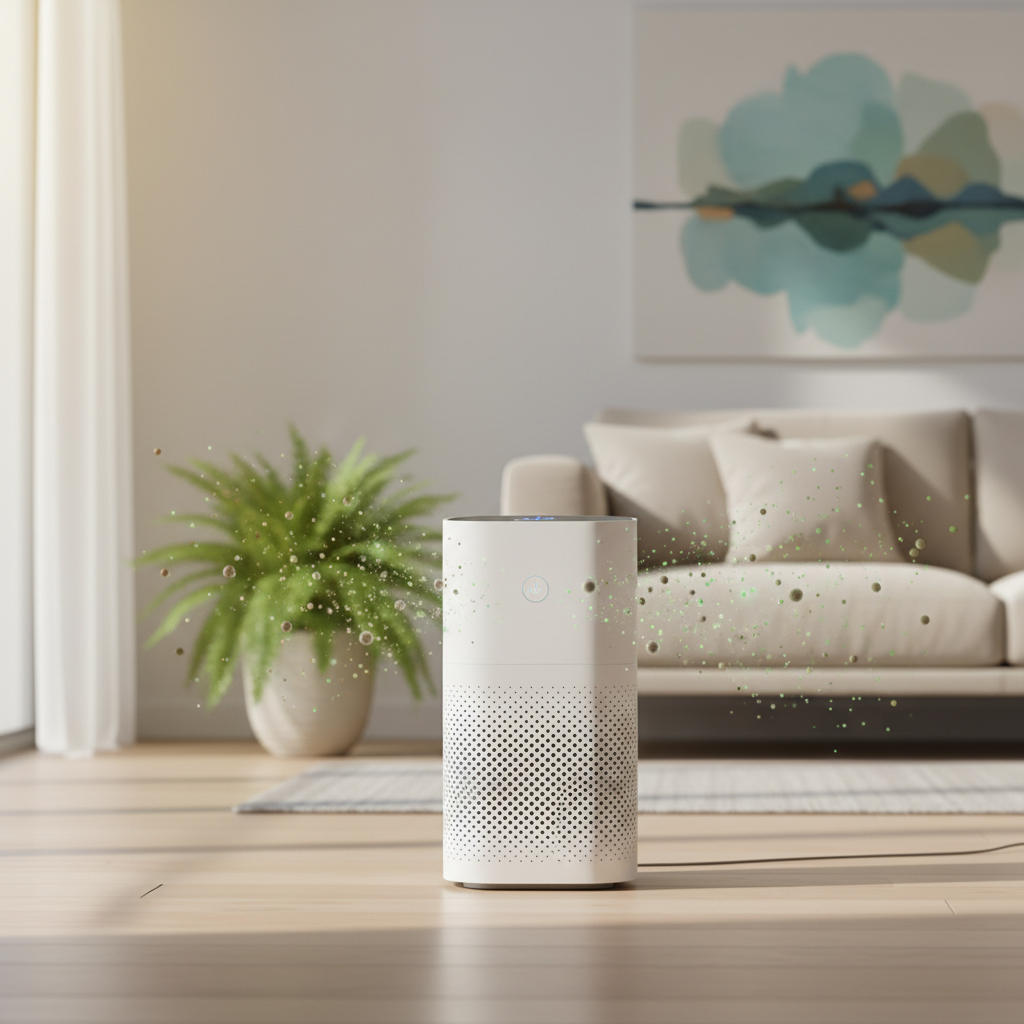
Air purifiers function by drawing in ambient air, passing it through a series of filters, and then releasing cleaner air back into the room. When it comes to mold spores, their primary mechanism is mechanical filtration. They capture these airborne particles, preventing them from being inhaled or settling on surfaces where they could potentially establish new mold colonies.
High-Efficiency Particulate Air (HEPA) filters are the gold standard for removing mold spores from the air. A true HEPA filter is designed to capture at least 99.97% of airborne particles as small as 0.3 microns. This is particularly effective against mold spores, which typically range in size from 1 to 40 microns, though some sources state 2 to 20 microns. The filtration process involves a dense mat of fibers that traps particles through a combination of impaction, interception, and diffusion, making them highly efficient even for particles smaller than 0.3 microns. By continuously circulating and cleaning the air, HEPA air purifiers significantly reduce the concentration of floating mold spores, offering a cleaner breathing environment.
Types of Air Purifiers and Their Effectiveness Against Mold
Selecting the right air purifier is crucial for effectively tackling mold spores. Different technologies offer varying degrees of effectiveness and address different aspects of mold-related air quality issues.
HEPA Air Purifiers
|
Our Picks for the Best Air purifier in 2026
As an Amazon Associate I earn from qualifying purchases.
|
||
| Num | Product | Action |
|---|---|---|
| 1 | Air Purifiers for Home Large Room Cover Up to 1500 Ft² with True HEPA Filter, 20dB Sleep Mode, 360° Air Intake & Outlet, Air Cleaner for Bedroom Pets, 7 Color Light, HAP604, Bright White |

|
| 2 | LEVOIT Air Purifier for Home Allergies Pet Hair in Bedroom, Covers Up to 1073 ft² by 56W High Torque Motor, AHAM VERIFIDE, 3-in-1 Filter with HEPA Sleep Mode, Remove Dust Smoke Odor, Core300-P, White |
|
| 3 | LEVOIT Air Purifiers for Home Large Room Up to 1875 Ft² with Washable Pre-Filter, AHAM VERIFIDE, Air Quality Monitor, HEPA Sleep Mode for Allergies, Pet Hair in Bedroom, Vital 200S-P, White |
|
| 4 | LEVOIT Air Purifier for Home Large Room Up to 1073Ft² with Air Quality Monitor, AHAM VERIFIDE, Smart WiFi, Washable Pre-Filter, HEPA Sleep Mode for Pets, Allergies, Dust, Pollen, Vital 100S-P, White |
|
| 5 | LEVOIT Air Purifiers for Bedroom Home Dorm, AHAM VERIFIED, 3-in-1 Filter Cleaner With Aroma Pad, Filters Smoke, Allergens, Pet Dander, Odor, Dust, Office, Desktop, Core Mini-P, White |
|
| 6 | LEVOIT Air Purifier for Home Bedroom Dorm Room, Smart & Voice Control, AHAM VERIFIED, 3-in-1 Filter With HEPA Sleep Mode, for Pollen, Pollutants, Smoke, Dander, Dust, Core 200S-P, White |
|
| 7 | Air Purifiers for Home with High Efficiency Filter Up to 1076 Ft² for Pet Hair, Odors, Pollen, Smoke, Compact Air Cleaner with 3 Speeds, Timer, Aroma Quiet 360°Intake Filter, White |
|
| 8 | Air Purifiers for Home Large Room, Cover Up to 2400 Ft² with True HEPA Filter, Smart Mode, PM2.5 Air Quality Display, 22dB Sleep Mode, Aromatherapy with 2X-Purification & 360°Air Outlet, HAP603 |
|
| 9 | KNKA Air Purifier for Home Bedroom Large Room Up to 1,695 Ft² in 1 Hr, HEPA Air Cleaner with Washable Pre-Filter, AHAM VERIFIDE, AQI Display, ECO Mode, Pet Mode for Pets, Dust, Pollen, APH4000 |
|
| 10 | FreAire Air Purifiers for Bedroom Up to 1086 Ft², Air Purifiers for Home with Lights, HEPA Air Purifier Removes Dust Smoke Pollen Dander Smell, for Home/Pets/Bedroom |
|
True HEPA air purifiers are the most recommended and effective option for removing airborne mold spores. Their densely woven fibers are certified to capture 99.97% of particles as small as 0.3 microns, encompassing the vast majority of mold spores. [cite: 3 (search 3), 4 (search 1)] This mechanical filtration ensures that spores are physically removed from the air. However, HEPA filters do not kill mold; they merely trap it. Once captured, the spores remain on the filter, necessitating regular filter replacement or cleaning to maintain efficiency and prevent potential growth on the filter itself if humidity is high.
Activated Carbon Air Purifiers
While not designed to capture mold spores directly, activated carbon filters are invaluable in a comprehensive mold strategy. Mold often produces unpleasant, musty odors and releases volatile organic compounds (VOCs) into the air. Activated carbon, with its porous structure, excels at adsorbing these gases and odors, neutralizing them rather than just masking them. [cite: 2 (search 1), 5 (search 2)] Many high-quality air purifiers for mold prevention will feature both a HEPA filter and an activated carbon layer to address both airborne spores and associated odors/VOCs.
Ionizers and UV-C Light Air Purifiers
Some air purifiers incorporate ionizers or UV-C light technology. Ionizers release charged ions that attach to airborne particles, causing them to settle out of the air or be more easily captured by filters. UV-C light aims to destroy microorganisms like mold spores, bacteria, and viruses. While these technologies might seem appealing, they come with caveats. Ionizers can sometimes produce ozone, a lung irritant and asthma trigger, which is generally advised against by health organizations. [cite: 5 (search 2)] UV-C light needs sufficient exposure time to be effective against mold spores, and its efficacy can vary within an air purifier’s fast-moving airflow. Furthermore, neither technology addresses the root cause of mold growth, nor do they physically remove spores from the air as effectively as HEPA filtration.
Air Purifiers Combining Multiple Technologies
The most effective air purifiers for mold spores often feature a multi-stage filtration system. This typically includes a pre-filter to capture larger particles like dust and pet dander, extending the life of subsequent filters. Following the pre-filter is a true HEPA filter for capturing mold spores and other fine particulates. Finally, an activated carbon filter targets odors and VOCs. This layered approach provides the most comprehensive protection against various airborne contaminants associated with mold.
Air Purifiers: A Complementary Solution, Not a Cure-All
It’s crucial to understand that while air purifiers are a powerful tool, they are a complementary solution to mold problems, not a standalone cure. An air purifier treats the symptoms—the airborne mold spores—but does not address the underlying cause of mold growth. [cite: 1, 5 (search 1)]
Mold growth is fundamentally a moisture problem. Whether it’s a leaky pipe, high indoor humidity, or water intrusion, mold will continue to thrive and release spores as long as moisture is present. Therefore, the primary and most critical step in managing mold is proper mold remediation. This involves identifying and fixing the source of moisture, then thoroughly cleaning and removing any visible mold growth. For extensive mold issues, professional mold remediation services are highly recommended. [cite: 1 (search 2)]
Beyond remediation, controlling indoor humidity is paramount for preventing mold recurrence. Mold spores lie dormant everywhere and only activate and grow when humidity levels are sufficiently high. Maintaining indoor humidity below 60%, ideally between 30% and 50%, is essential. A dehumidifier is often the most effective tool for this, working in tandem with an air purifier to both remove airborne spores and prevent new growth. [cite: 5 (search 1)] Without addressing the moisture source, an air purifier will be fighting a losing battle, continuously filtering new spores produced by an active, unchecked mold colony.
“Air purifiers are excellent for capturing airborne mold spores, but they are a piece of the puzzle, not the entire solution. You must eliminate the moisture source and clean existing mold for true long-term relief.” – Admin, Reviewlized.com, Air Purifier Expert
Key Factors When Choosing an Air Purifier for Mold Spores
When you’re ready to invest in an air purifier to combat mold spores, several critical factors should guide your decision to ensure you select the most effective unit for your needs.
Room Size and CADR Rating
The Clean Air Delivery Rate (CADR) indicates how quickly an air purifier can clean a room of a specific size. For mold spores, look for a CADR rating appropriate for the square footage of your room. A higher CADR means faster air cleaning. Always choose a purifier that matches or exceeds the recommended CADR for your space to ensure efficient spore removal.
True HEPA Filtration
This is non-negotiable for mold spores. Ensure the air purifier specifies “True HEPA” filtration, meaning it meets the Department of Energy’s standard of capturing 99.97% of particles as small as 0.3 microns. Beware of terms like “HEPA-like” or “HEPA-type,” which do not meet the same rigorous standards.
Activated Carbon Filter
While HEPA handles the spores, an integrated activated carbon filter is vital for absorbing the musty odors and harmful volatile organic compounds (VOCs) that mold often produces. Look for a substantial amount of activated carbon for effective odor removal.
Noise Level
Air purifiers are often run continuously, especially when dealing with mold. Consider the noise level, measured in decibels (dB), particularly if the unit will be in a bedroom or living area. Many modern purifiers offer quiet operation modes or sleep settings.
Filter Lifespan and Replacement Costs
Filters need regular replacement to maintain efficiency. Research the cost and frequency of filter changes. Some multi-stage systems may have filters with different lifespans. Factor these ongoing costs into your budget. Units with washable pre-filters can help extend the life of HEPA filters.
Smart Features and Brand Reputation
Modern air purifiers may include features like smart sensors that detect air quality, automatic fan speed adjustment, timers, remote control via smartphone apps, and filter replacement indicators. While not essential for filtration, these features enhance user convenience. Choose reputable brands known for quality and customer support.
Buying Guide: Steps to Integrate an Air Purifier into Your Mold Strategy
Integrating an air purifier effectively into your home’s mold strategy requires a systematic approach, ensuring you tackle the problem comprehensively rather than just superficially.
Address the Source First
The absolute first step is to identify and resolve the source of moisture causing the mold growth. This might involve repairing leaky pipes, fixing roof issues, or addressing condensation problems. Without eliminating the moisture source, mold will inevitably return, making any other efforts temporary. Following moisture control, thoroughly clean and remediate any existing mold growth, hiring professionals for larger areas.
Select the Right Technology
Once the source is managed, choose an air purifier equipped with a true HEPA filter to capture airborne mold spores. For added benefit, especially if odors or VOCs are a concern, opt for a model that also includes an activated carbon filter. Avoid ozone-generating ionizers or UV-C purifiers as primary mold solutions due to their limitations and potential side effects.
Optimal Placement
Strategically place your air purifier in the rooms most affected by mold or where mold spores are likely to be disturbed, such as basements, bathrooms, or other humid areas. [cite: 2 (search 1)] Positioning it in a central location within the room, away from walls and furniture, allows for optimal air circulation and purification.
Regular Maintenance
Adhere strictly to the manufacturer’s recommendations for filter cleaning and replacement. Clogged filters lose their efficiency and can even become a breeding ground for bacteria if not maintained. Regular maintenance ensures your air purifier continues to operate at peak performance, effectively removing spores.
Monitor Humidity Levels
Invest in a hygrometer to monitor your indoor humidity levels. Aim to keep humidity between 30% and 50% to inhibit mold growth. If humidity consistently remains high, consider running a dehumidifier alongside your air purifier to tackle both airborne spores and the environmental conditions that allow mold to thrive. This dual approach offers robust protection.
Top Air Purifier Recommendations for Mold Spores
While specific models and brands can vary in availability and features, the best air purifiers for combating mold spores consistently share core characteristics. When selecting a unit, prioritize those offering robust multi-stage filtration. Look for models with a high CADR (Clean Air Delivery Rate) suitable for your room size, ensuring rapid air turnover and effective spore removal. Essential components include a pre-filter, a true HEPA filter capable of capturing 99.97% of particles down to 0.3 microns, and a substantial activated carbon filter to tackle mold-related odors and volatile organic compounds. Brands with strong reputations for air quality and those offering transparent filter specifications and easy maintenance are generally reliable choices. Always read recent reviews and consider your specific needs, such as noise level and smart features, before making a purchase.
Effective Usage and Maintenance for Mold Prevention
Maximizing the effectiveness of your air purifier against mold spores goes beyond just purchasing the right unit; it involves proper usage and diligent maintenance.
Running Your Air Purifier Effectively
For areas with known mold issues or high humidity, running your air purifier continuously, or at least for several hours daily, is often recommended. This ensures constant air circulation and filtration, keeping airborne spore levels low. Use the appropriate fan speed for your room size; higher speeds clean the air faster but can be louder. Many purifiers have auto modes that adjust fan speed based on detected air quality, providing an efficient and hands-off approach.
Filter Cleaning and Replacement
The efficiency of your air purifier is directly tied to the condition of its filters. Clogged or dirty filters can reduce airflow and become less effective at capturing particles. Follow the manufacturer’s guidelines for cleaning pre-filters and replacing HEPA and activated carbon filters. Typically, pre-filters can be washed or vacuumed regularly, while HEPA and carbon filters require replacement every 6-12 months, depending on usage and air quality. Neglecting filter maintenance can not only diminish performance but also potentially re-release captured particles into the air.
Complementary Practices
An air purifier works best as part of a broader strategy. Ensure adequate ventilation in your home, especially in moisture-prone areas like bathrooms and kitchens, by using exhaust fans or opening windows when conditions allow. Regularly clean surfaces with appropriate mold-killing cleaners to remove settled spores and prevent new growth. Most importantly, consistently monitor and control indoor humidity levels, ideally with a dehumidifier, to tackle the root cause of mold. By combining air purification with these proactive measures, you create a robust defense against mold and maintain a healthier indoor environment.
Conclusion
Air purifiers are indeed valuable allies in the fight against mold spores, offering a significant reduction in airborne contaminants and helping to alleviate allergy and asthma symptoms. Their true HEPA filters are highly effective at capturing the microscopic spores that can compromise our respiratory health. However, it’s vital to remember that an air purifier is a tool for managing symptoms, not a standalone cure.
For lasting relief and a truly healthy indoor environment, a comprehensive approach is essential. This involves addressing the source of moisture that allows mold to thrive, thoroughly remediating any existing growth, and maintaining optimal humidity levels. When combined with these crucial steps, a high-quality air purifier with HEPA and activated carbon filtration becomes an indispensable part of your home’s defense system, ensuring the air you breathe is as clean and safe as possible. What steps will you take today to secure your home against mold’s unseen threat?
Frequently Asked Questions
What is the ideal humidity level to prevent mold?
To prevent mold growth, it is generally recommended to maintain indoor humidity levels between 30% and 50%. Mold thrives in environments with relative humidity above 60%, so keeping your home within the ideal range significantly reduces its ability to grow and spread.
Can an air purifier kill mold?
No, a standard air purifier, even with a HEPA filter, cannot kill mold. Its primary function is to capture and remove airborne mold spores from the air. To eliminate active mold growth, you must address the moisture source and clean or remediate the mold from surfaces.
How often should I run my air purifier for mold?
For effective mold spore removal, it’s generally best to run your air purifier continuously, or at least for several hours daily, especially in rooms prone to mold or where spores are likely to be disturbed. This ensures consistent air circulation and filtration, keeping airborne spore levels low.
Do all air purifiers help with mold?
Not all air purifiers are equally effective against mold. Only air purifiers equipped with a true HEPA filter are certified to capture the vast majority of mold spores. Other technologies like ionizers or basic filters may not be as effective or could even produce harmful byproducts like ozone.
What micron size are mold spores?
Mold spores typically range in size from 1 to 40 microns, although some sources specify a range of 2 to 20 microns. [cite: 1 (search 3)] This size range makes them easily captured by true HEPA filters, which are designed to trap 99.97% of particles as small as 0.3 microns.